Table of Contents
- When Electronic Security Countermeasures for Executives Matter
- Technical Surveillance Countermeasures (TSCM): What a Real Inspection Covers
- Electronic Eavesdropping Detection: Finding Hidden Listening Devices
- Wireless and RF Security: Closing the Invisible Leaks
- The Executive Security Assessment: Mapping Your Exposure Before You Buy
- TSCM vs. Standard Security Audit: Two Jobs, Two Different Teams
- What to Do When You Suspect Surveillance
- Building a Countermeasures Program That Holds Up
- Frequently Asked Questions
Last Updated: October 8, 2026
When Electronic Security Countermeasures for Executives Matter
Most executive protection plans guard the body and ignore the room. That gap is where electronic security countermeasures for executives earn their place: they find the microphones, cameras, and wireless leaks that physical security never touches. At Special Solutions, Ltd., we've run these sweeps for over three decades, and the pattern rarely changes. The threat is quiet, cheap, and already inside the building.
Three signals tell you it's time to act:
- A sensitive deal leaks before it closes
- A board member's travel or health details surface in the wrong hands
- A terminated employee still seems to know internal decisions
Any one of those is enough to justify a professional inspection. Waiting for proof of a device means you've already lost the information.
Technical Surveillance Countermeasures (TSCM): What a Real Inspection Covers
Technical surveillance countermeasures (TSCM) is the practice of detecting and neutralizing hidden surveillance devices, including listening bugs, covert cameras, and unauthorized transmitters, through a physical and electronic sweep of a space. A real inspection covers both, not just one.
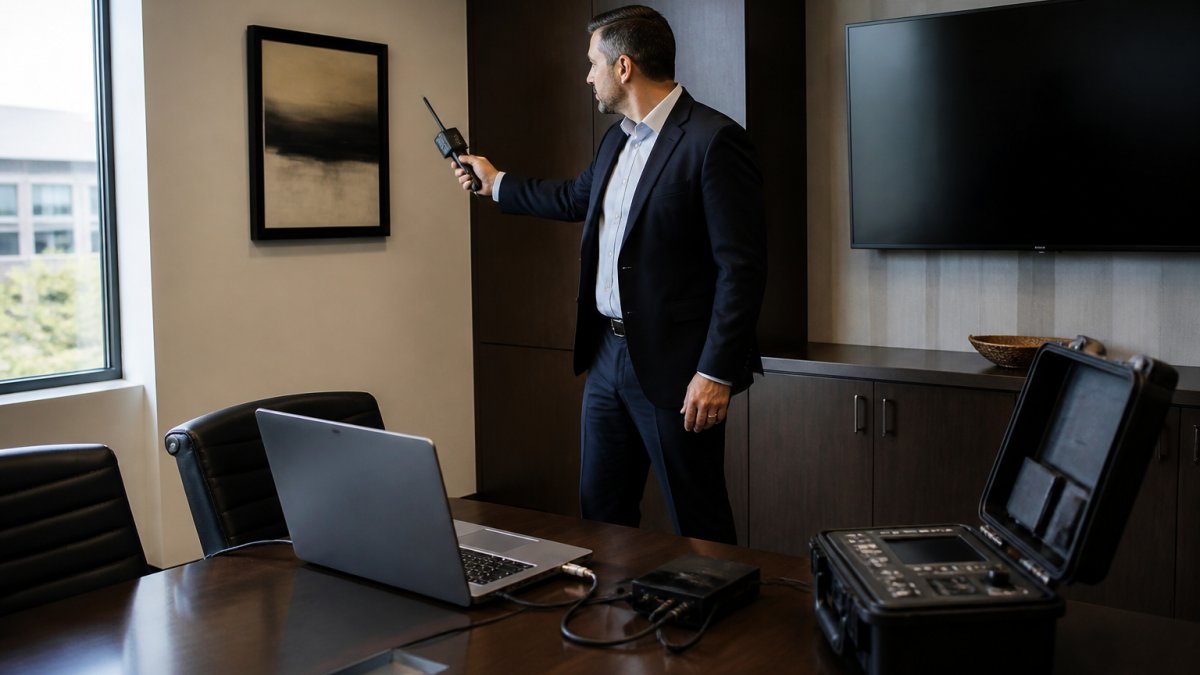
The work splits into two halves. Skip either one and you'll miss devices.
Physical and Electronic Sweep Categories
A thorough TSCM inspection covers four categories:
- Physical search: Checking walls, vents, furniture, and fixtures by hand
- RF detection: Scanning for radio frequencies that shouldn't be there
- Electronic sweep: Testing wiring, phones, and power lines for taps
- Infrared and thermal: Finding cameras and heat signatures in dark corners
Most guides treat these as separate services. In practice, they overlap. A bug hidden in a phone line shows up in both the physical search and the electronic sweep.
Electronic Eavesdropping Detection: Finding Hidden Listening Devices
Electronic eavesdropping detection is the process of locating devices that capture audio, video, or data without the owner's knowledge. The hard part isn't the technology. It's knowing where to look.
A common mistake is assuming modern bugs look like the old movie version: a wire and a battery. Today's devices are the size of a coin and can run for months. So we check the places nobody thinks about:
- Power outlets and light switches
- Smoke detectors and thermostats
- Picture frames and wall clocks
- Under desks and inside chair cushions
- Phone handsets and conference speakerphones
Wireless and RF Security: Closing the Invisible Leaks
Wireless and RF security means controlling the radio signals that carry your conversations and data out of the building. Every wireless device is a potential exit door. Most executives never count them.
Start with an inventory. You can't secure what you haven't listed:
- Wi-Fi access points and guest networks
- Bluetooth devices, including headsets and keyboards
- Cordless phones and wireless microphones
- Smart TVs, cameras, and building systems
- Personal hotspots carried by staff
The fix is usually policy, not hardware. Turn off what you don't need. Segment guest networks from internal ones. Ban personal hotspots in rooms where sensitive talks happen. For guidance on wireless risk, the National Institute of Standards and Technology cybersecurity framework sets a baseline many firms follow.
The Executive Security Assessment: Mapping Your Exposure Before You Buy
An executive security assessment is a structured review of what you have to protect, who wants it, and where you're exposed. It comes before any sweep, not after. Buying equipment first is like locking doors before you know which ones are broken.
Your assessment should answer three questions:
| Question | What It Uncovers | Typical Action |
|---|---|---|
| What are we protecting? | Deals, IP, personal data, reputations | Rank assets by sensitivity |
| Who wants it? | Competitors, insiders, bad actors | Match threat to asset |
| Where are the gaps? | Rooms, devices, habits, travel | Set sweep and policy priorities |
Run the assessment once, then revisit it when leadership, offices, or major deals change. Exposure shifts. Your map should too.
Start a confidential consultation →
TSCM vs. Standard Security Audit: Two Jobs, Two Different Teams
TSCM and a standard security audit are not the same job, and one team rarely does both well. A security audit reviews policy, access, and process. TSCM hunts for hardware and signals. Confusing the two leaves you with a clean policy binder and a live microphone.
Here's the split in plain terms:
- Security audit: Reviews how people and systems are supposed to work
- TSCM: Proves whether the room is actually clean right now
- Audit output: Findings and recommendations
- TSCM output: Confirmed devices, locations, and a clean report
For legal matters, the difference matters even more. Evidence has to be gathered in a way a court will accept. The Federal Trade Commission guidance on business data practices and similar standards shape how firms handle sensitive data. A TSCM provider that documents its work properly gives you a record you can use later.
What to Do When You Suspect Surveillance
When you suspect surveillance, don't confront anyone or start moving furniture. Both tip off the person watching and can destroy the evidence you need. Act quietly and in order.
Follow these steps:
- Say nothing to anyone outside a small trusted group
- Stop holding sensitive meetings in the suspect room
- Document what you noticed and when
- Call a professional TSCM team for a discreet sweep
- Preserve findings in a written report
- Decide on legal or HR action with counsel
The order matters. A rushed confrontation is the fastest way to lose both the device and the case. At Special Solutions, Ltd., we handle these calls with the discretion the situation demands, and we build a record suitable for legal proceedings.
Building a Countermeasures Program That Holds Up
A countermeasures program that holds up is one that runs on a schedule, not on fear. One sweep after a scare fades within months. A program keeps the room clean year after year.
Build it around four habits:
- Schedule sweeps: High-risk rooms on a set cycle, not just after incidents
- Train staff: Teach people what to watch for and who to call
- Control devices: Know every wireless device in sensitive spaces
- Keep records: Document every inspection for legal and audit use
The Cybersecurity and Infrastructure Security Agency offers free resources that help smaller teams build the basics. Pair those with a professional TSCM partner for the sweeps themselves.
The biggest mistake is treating this as a one-time purchase. Threats evolve. Devices get smaller and cheaper every year. Your program has to keep pace.
Sensitive rooms don't stay clean on their own, and the cost of a missed device is measured in lost deals and damaged trust. Special Solutions, Ltd. brings over three decades of investigative and electronic security experience to every engagement, with investigators prepared to testify in court and documented evidence compiled into reports suitable for legal proceedings. Our team handles each case with the confidentiality the situation requires. Start a confidential consultation with Special Solutions, Ltd. and get a clear picture of your exposure before it costs you.
Frequently Asked Questions
What are electronic security countermeasures for executives?
They are the technical and procedural steps that keep an executive's spoken and written information from being intercepted. That includes TSCM sweeps for hidden transmitters, RF and wireless monitoring, device hardening, and a written response plan for suspected surveillance. The goal is not paranoia, it is protecting board discussions, legal strategy, and travel plans before a leak becomes a loss. A qualified provider will scope the work to your actual exposure, not sell a fixed package.
How often should an executive office or residence receive a TSCM inspection?
A common baseline is quarterly for a primary office and semiannually for a primary residence, with additional sweeps before any high-stakes meeting, merger announcement, or litigation event. The right cadence depends on your threat profile, building access, and staff turnover. A new lease, a renovation, or a change in cleaning contractors all justify an out-of-cycle inspection. Ask your provider to document each sweep so you can show a consistent pattern of due diligence if a matter ever reaches court.
How can executives reduce risks from wireless and RF devices?
Start with inventory: know every wireless access point, Bluetooth device, and smart appliance in the space. Segment guest Wi-Fi from the network that carries sensitive calls, disable unused radios, and require approval before any new device joins. A periodic RF survey catches rogue access points and unexpected transmitters that a visual walkthrough would miss. For executives who travel, a portable RF detector and a policy of never discussing sensitive matters in unfamiliar rooms closes the most common gap.
What is the difference between a TSCM inspection and a standard security audit?
A standard security audit reviews policies, access control, cameras, and physical vulnerabilities. A TSCM inspection is a technical hunt for active and passive surveillance devices, using spectrum analyzers, non-linear junction detectors, and thermal imaging. They answer different questions. An audit tells you whether the door locks properly; a TSCM sweep tells you whether someone is listening through the wall. Many organizations need both, and a good provider will say so rather than sell one as a substitute for the other.