Table of Contents
- The Four Requirements for Admissible Evidence
- How to Authenticate Evidence in Court: A Step-by-Step Workflow
- Hearsay, Foundation, and Objections Explained with Examples
- Chain of Custody for Evidence: Documentation That Withstands Challenge
- Evidence Preservation Checklist for Digital and Physical Items
- When Is Video Evidence Admissible in Court?
- Pretrial Disclosure, Exhibit Preparation, and Filing Deadlines
- Conclusion: Building a Record That Holds Up
- Frequently Asked Questions
Last Updated: October 6, 2026
The Four Requirements for Admissible Evidence
Ensuring evidence is admissible in court means clearing four tests: relevance, materiality, competence, and a proper foundation. Miss any one of them, and the judge can strike it, no matter how convincing it looks. At Special Solutions, Ltd., we build every investigation around those four tests from day one, because ensuring evidence is admissible in court starts long before anyone steps into a hearing room.
Here is how each requirement works:
- Relevance means the evidence makes a fact in the case more or less likely.
- Materiality means that fact actually matters to the claims or charges.
- Competence means the law does not bar the evidence, such as a witness who lacks firsthand knowledge.
- Foundation means you can show where the item came from and that it has not been altered.
The Federal Rules of Evidence govern federal cases, while most state courts follow their own rules of evidence. The wording differs, but the core logic stays the same.
Judges weigh reliability and credibility closely. A clean record beats a dramatic one every time.
How to Authenticate Evidence in Court: A Step-by-Step Workflow
Authentication is the process of proving that an item is what you claim it is.
Total Time: Varies by case, but plan weeks, not days. Digital authentication often takes longer because exports and metadata review add steps.
What You'll Need: Original items or files, custody records, witness statements, hash values for digital items, and a clear exhibit list.
- Identify the item. Give every piece of evidence a unique number and describe it in writing. For digital files, record the file name, format, size, and the device it came from.
- Document its origin. Record who found it, when, where, and how. For a phone or laptop, note the make, model, and whether it was locked or encrypted.
- Track every transfer. Log each person who handled it, with dates and signatures. For digital evidence, log each copy, export, and transfer of the file, not just the device.
- Preserve the original. Store physical items safely and work only from copies. For digital evidence, image or clone the source drive before you open anything, and keep the original untouched.
- Capture a hash value. A cryptographic hash (such as SHA-256) is a unique fingerprint of a file. Record the hash at collection and again before trial. If the two match, you can show the file has not changed.
- Match it to testimony. Have a witness confirm the item is what it appears to be. For digital evidence, that witness may be the person who collected it, the custodian of the system, or someone with knowledge of how the file was created.
- Prepare a foundation statement. Draft the questions that establish authenticity. For digital items, be ready to explain how the file was extracted, what tool was used, and how metadata was preserved.
- Anticipate objections. Know the weak points before the other side raises them, and have your hash records and custody log ready to answer.
Expected Result: A court-ready exhibit with a paper trail a judge can follow without gaps, including a verifiable record that digital items were not altered.
Why digital authentication is different. Physical items can often be authenticated by a witness who recognizes them.
Hearsay, Foundation, and Objections Explained with Examples
Hearsay is an out-of-court statement offered to prove the truth of the matter stated. It is generally inadmissible unless an exception applies.
Foundation is the groundwork that connects evidence to the case. Objections are how the other side tests both.
A few examples make this clearer:
- A witness says, "My neighbor told me the car was red." That is hearsay if offered to prove the car was red.
- A signed receipt showing a payment is documentary evidence, not hearsay, because it is a record, not a spoken claim.
- A photo with no witness to confirm when it was taken lacks foundation.
Common objections include relevance, lack of foundation, hearsay, and best evidence. Each one targets a different weakness. Knowing them in advance lets you shore up your exhibits before the hearing.
Chain of Custody for Evidence: Documentation That Withstands Challenge
A chain of custody is the written record of who handled a piece of evidence, when, and why. It is the single most common point of failure in contested cases.
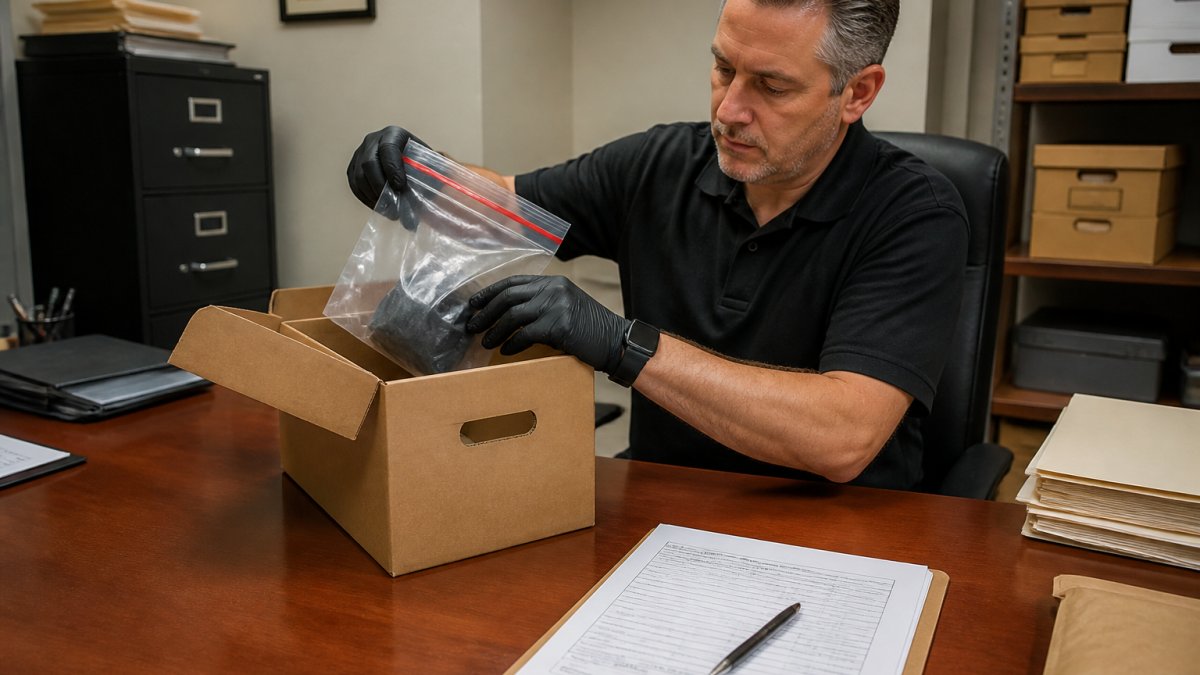
Every entry needs five things:
- The date and time of the transfer
- The name and signature of the person releasing the item
- The name and signature of the person receiving it
- A brief note on the item's condition
- The reason for the transfer
Keep records in ink or a locked digital system. Store originals in a secure location with limited access. When a challenge comes, the record speaks for you.
Evidence Preservation Checklist for Digital and Physical Items
Preservation means keeping evidence in its original state until it is presented. Both physical and digital items need a plan.
Use this checklist:
Start a confidential consultation →
- Label every item with a unique ID
- Store physical items in a sealed, climate-controlled space
- Photograph items before and after handling
- Copy digital files without altering the original
- Record file metadata, including creation and last-modified dates
- Back up digital evidence to a second secure location
- Log every access to stored evidence
- Review the log monthly for gaps
For digital evidence, metadata matters as much as the file itself. A copy without its metadata may not survive an authentication challenge. The National Institute of Standards and Technology publishes guidance on handling digital evidence that many investigators follow.
When Is Video Evidence Admissible in Court?
Video evidence is admissible when it is relevant, authentic, and not unfairly prejudicial. Someone must testify that the video accurately shows what it claims to show. That much is standard.
The three-part test, applied.
- Authenticity. Can a witness confirm the video is unaltered and shows what it claims? Under Rule 901, this can be done through a witness with knowledge, through a system or process that produces an accurate result, or through evidence that the video was made in the course of a regularly conducted activity.
- Relevance. Does it show something that matters to the case? A video of an unrelated argument does not become relevant just because the same people appear in it.
- Fairness. Does its probative value outweigh any unfair prejudice? Under Rule 403, a judge can exclude even authentic video if its emotional impact substantially outweighs its usefulness.
Authentication depends on the source.
- Surveillance video. Usually authenticated by the custodian of the system, who testifies about how the system records, stores, and retrieves footage. The custodian does not need to have watched the event.
- Body camera footage. Usually authenticated by the officer who wore the camera, who testifies that the device was working and that the footage has not been altered. Departments often maintain their own chain-of-custody systems.
- Cell phone video. Usually authenticated by the person who recorded it, who testifies about when, where, and how it was captured. If that person is unavailable, you may need metadata or a forensic examination to establish authenticity.
The silent witness theory. Some video has no human witness to the recording. Courts may admit it under the "silent witness" theory if the proponent shows the camera was working properly, the recording process was reliable, and no one tampered with the footage. This is common with fixed surveillance systems.
What to check before you rely on video.
- Preserve the original file, not a re-encoded or edited copy. Re-encoding can strip metadata and create gaps.
- Record the hash value of the original file at collection.
- Document the export process: what tool was used, what settings, and whether metadata was retained.
- Get a written statement from the custodian or recorder.
- Check the local rules and the judge's standing orders. Some courts require pretrial disclosure of video exhibits and a specific foundation offer.
Jurisdiction and case-type differences. Rules of evidence vary by state, and some courts apply special rules for certain case types. A video that is admissible in one court may face a different foundation requirement in another.
Pretrial Disclosure, Exhibit Preparation, and Filing Deadlines
Most evidence fails before trial, not during it. Pretrial disclosure rules require you to share exhibits with the other side by a set deadline, and missing it can bar the evidence entirely.
Follow these steps:
- Build your exhibit list early.
- Number and label each exhibit clearly.
- Serve copies on the other side by the deadline.
- File the list with the court as local rules require.
- Prepare a clean copy for the judge and a working copy for yourself.
Deadlines vary by court and case type. Check the federal court local rules or your state's rules for the exact timeline. When in doubt, file early.
Conclusion: Building a Record That Holds Up
The hardest part of any case is not finding evidence. It is keeping that evidence clean enough to survive a challenge. Every gap in a custody log, every missing signature, gives the other side an opening.
Special Solutions, Ltd. has handled sensitive investigations since 1991. Our investigators compile documented evidence into reports built for legal proceedings, and we are prepared to testify when a case demands it. We work discreetly, because confidentiality often matters as much as the findings.
If you need evidence that stands up in court, start a confidential consultation with Special Solutions, Ltd. and get a record you can rely on.
Frequently Asked Questions
What makes evidence admissible in court?
Evidence is admissible when it clears four hurdles: relevance, materiality, competence, and a proper foundation. The evidence must tend to prove or disprove a fact in the case, relate to a fact the court actually needs to decide, come from a source the law permits, and be authenticated by a witness who can explain what it is and where it came from. Failing any one of these tests gives the opposing party grounds for an objection.
How do you authenticate evidence in court?
Authentication means showing the item is what you claim it is. For physical items, a witness with personal knowledge testifies to where it came from and how it was handled. For documents, you may use a custodian's records or a stipulation. For digital files, you typically present metadata, hash values, or system logs. Under Federal Rule of Evidence 901, the bar is a reasonable juror could find the item authentic, not absolute certainty.
Can video evidence be used in court?
Yes, if you can authenticate it. Video evidence admissible in court requires testimony that the recording accurately depicts the scene, that the equipment worked properly, and that the file was not altered. Metadata, original file formats, and a documented chain of custody strengthen the foundation. Gaps in custody or signs of editing give opposing counsel grounds to challenge reliability, so keep the original file untouched and work only from copies.
What happens if the chain of custody is broken?
A break in the chain does not automatically make evidence inadmissible, but it shifts the burden. Opposing counsel can argue the item was tampered with, contaminated, or swapped. The judge then weighs the gap's length, who had access, and whether anyone could have altered the item. A single undocumented transfer can be explained; multiple gaps or missing signatures often lead to exclusion, especially in criminal matters.