Table of Contents
- What TSCM Services Actually Cover
- Step 1: Define Your Threat and Scope
- Step 2: Verify TSCM Specialist Qualifications and Certification
- Step 3: Ask Critical Questions to Ask a TSCM Provider
- Step 4: Understand TSCM Equipment and Detection Methods
- Step 5: Evaluate TSCM Sweep Cost and Pricing Structure
- Red Flags When Hiring a TSCM Specialist
- What to Expect After Your TSCM Sweep
- Frequently Asked Questions
Last Updated: October 17, 2026
What TSCM Services Actually Cover
Technical surveillance countermeasures (TSCM) is the practice of identifying and neutralizing electronic surveillance threats, and understanding how to hire a tscm specialist is essential for protecting your privacy and security.
TSCM goes beyond bug sweeps, addressing hidden physical devices, compromised networks, phone line interception, and unauthorized RF transmissions.
Scope depends on your situation: corporate clients need office inspections to protect proprietary information, attorneys need court-defensible evidence, and executives need residential and vehicle inspections.
Each engagement begins with a threat assessment to define what you're protecting against and where surveillance is most likely.
Step 1: Define Your Threat and Scope
Before you learn how to hire a tscm specialist, clarify what you're protecting. This determines the scope of work, equipment, and cost.
Ask yourself these questions:
- What information or assets are you protecting? (proprietary data, personal privacy, legal strategy, executive communications)
- Where is the threat most likely? (office, home, vehicle, conference room, phone lines)
- Who might be conducting surveillance? (competitors, disgruntled employees, external parties, unknown threat actors)
- What's your timeline? (urgent, routine, ongoing monitoring)
- What's your budget range? (this guides the depth and frequency of sweeps)
A vague threat assessment leads to incomplete work.
Residential and corporate clients need different coverage: a homeowner worried about hidden cameras differs from a law firm protecting attorney-client communications.
Define your scope in writing before contacting a TSCM provider to prevent misunderstandings.
Step 2: Verify TSCM Specialist Qualifications and Certification
Not every security consultant is qualified to conduct TSCM work.
Look for these qualifications:
- Active licensing: Private investigator license in your state (required in most jurisdictions for TSCM work)
- TSCM-specific training: Formal coursework in counter-surveillance, electronic detection, or technical security
- Equipment certification: Hands-on experience with industry-standard detection equipment
- Professional memberships: Involvement with security associations or investigative boards
- Court testimony experience: Track record of providing admissible evidence for litigation
Ask the TSCM specialist directly about credentials and request proof of licensing and training. A reputable firm provides references without hesitation.
Experience matters more than generic security credentials.
Check whether the specialist has worked with clients in your industry.
Special Solutions, Ltd. maintains active licensing and board involvement in professional investigative and security organizations.
Step 3: Ask Critical Questions to Ask a TSCM Provider
The questions you ask reveal whether a TSCM specialist understands your situation and can deliver defensible results.
Ask these questions:
-
What's your process for threat assessment? A good answer explains how they'll evaluate your specific situation before the sweep. Poor answer: "We just sweep everything."
-
What equipment do you use, and why? They should name specific detection tools and explain what each one finds. Vague answers suggest limited technical knowledge.
-
How do you document findings? For litigation, documentation matters. Ask whether they provide written reports, photographs, and chain-of-custody documentation.
-
What happens if you find something? The answer should include notification procedures, evidence preservation, and next steps. They shouldn't promise to "remove" devices without legal guidance.
-
How long does a typical sweep take? A rushed inspection is incomplete.
-
Can you testify if needed? If you might need court evidence, confirm they're willing and experienced in providing testimony.
-
What's your pricing structure? Understand whether they charge hourly, flat-fee, or by location. Ask what's included and what costs extra.
-
How do you maintain confidentiality? Your TSCM engagement itself may be sensitive. Confirm they have confidentiality protocols and don't discuss clients publicly.
-
Do you work with legal counsel? The best TSCM specialists coordinate with attorneys to ensure findings are legally defensible.
-
What's your experience with this type of threat? Match their background to your situation. Corporate espionage requires different expertise than personal security.
Listen for specificity. Vague responses suggest they lack deep expertise.
Start a confidential consultation →
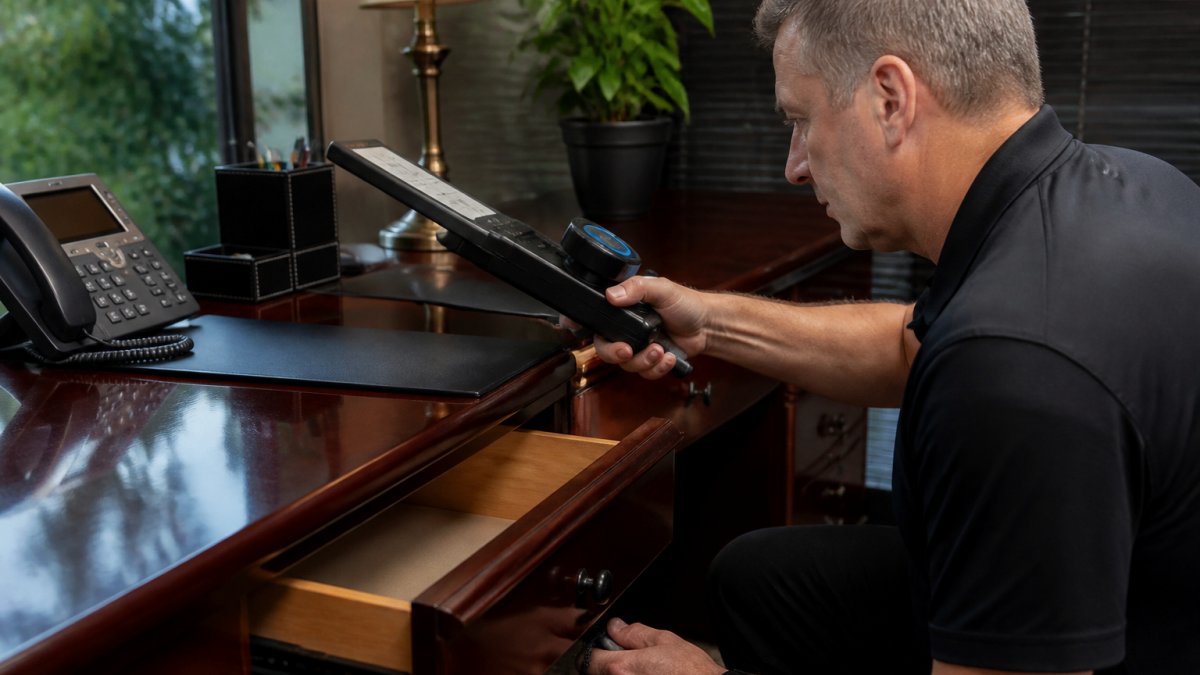
Step 4: Understand TSCM Equipment and Detection Methods
Equipment matters, but equipment alone does not find devices.
The core equipment categories
- Radio frequency (RF) spectrum analyzers and broadband receivers. These map all RF activity in a space and flag unauthorized transmitters. Ask whether the unit is current-generation and covers the frequency ranges used by modern devices, including cellular and Wi-Fi bands.
- Non-linear junction detectors (NLJD). These find electronics that are powered off or not transmitting, a hidden recorder, for example, by detecting semiconductor junctions. Ask how the specialist distinguishes a real threat from legitimate electronics.
- Thermal imaging. Useful for spotting heat signatures from devices hidden in walls, ceilings, or furniture, but only when the device is powered. Ask how they account for devices in sleep mode.
- Physical inspection tools. Borescopes, fiber-optic scopes, and magnification tools for examining outlets, vents, light fixtures, and furniture seams.
- Telephone and line analyzers. For detecting taps, line transmitters, and unauthorized connections on phone and network lines.
The method sequence a competent provider follows
- Pre-sweep threat assessment and floor plan review. The specialist should ask what you are protecting and where sensitive conversations happen before touching equipment.
- Physical and visual inspection. A systematic walkthrough of every room, starting with the most sensitive spaces, examining common concealment points: smoke detectors, outlets, vents, ceiling tiles, light fixtures, furniture, and wall art.
- RF spectrum sweep. A methodical scan of each room, not a single pass with a handheld detector. Ask how long they dwell in each room.
- NLJD and thermal inspection. Targeted at walls, ceilings, and furniture where a powered-off device could hide.
- Line and network inspection. Phone, data, and power lines checked for taps and unauthorized devices.
- Documentation. Photographs, equipment logs, and a written record of every location inspected, including locations where nothing was found.
- Report and debrief. Findings, limitations, and recommendations.
Questions that separate method from marketing
- Is your equipment calibrated, and how often? Uncalibrated RF gear produces unreliable results.
- How long do you spend in each room, and what determines that?
- How do you distinguish a legitimate device (a wireless access point, a smart speaker) from a threat?
- What do you do when a room is cluttered or has heavy RF background from nearby cell towers or Wi-Fi?
- Do you inspect powered-off devices, and how?
What the report should document about method
A defensible report records the equipment used, calibration status, inspection sequence, rooms checked, and any limitations. A report saying only "sweep conducted, no devices found" will not withstand litigation scrutiny.
Equipment is a means, not the deliverable. The deliverable is a documented, repeatable inspection you can rely on and defend.
Step 5: Evaluate TSCM Sweep Cost and Pricing Structure
TSCM pricing varies because the work is custom, but the drivers are predictable. Understanding them lets you compare quotes apples-to-apples and spot a lowball bid.
What actually drives the price
- Square footage and room count. A single conference room is a different job than a 20,000-square-foot office floor. Most providers price by the room or by the hour, and a thorough sweep of a standard executive office typically runs several hours before report writing.
- Property type. A residential sweep of a 3,000-square-foot home is usually a half-day to full-day engagement. Corporate suites, law firms, and executive vehicles add complexity from phone systems, network closets, and multiple private offices.
- Threat level and history. A routine baseline sweep costs less than an active-investigation sweep where the specialist must document chain of custody, preserve evidence, and coordinate with counsel.
- Travel and after-hours scheduling. Remote locations and weekend or overnight work carry premiums. Ask whether travel is billed at cost or as a flat add-on.
- Report depth. A basic findings memo is cheaper than a litigation-ready report with photographs, equipment logs, and testimony availability.
Pricing structures you will see
- Hourly. Common for investigations and multi-location work. Ask for the blended rate for inspection versus report writing, they are often different.
- Flat fee per location. Easier to budget, but confirm what square footage and room count the flat fee assumes. A flat fee that excludes report writing is not a flat fee.
- Project or retainer. Used for ongoing monitoring or multi-site corporate programs.
Questions that expose the real cost
- Is the quote inclusive of report preparation, or is that billed separately?
- What square footage and room count does this quote assume, and what triggers an overage?
- Is travel billed at cost, at a flat rate, or included?
- What is the charge for a follow-up sweep or a re-inspection after remediation?
- If devices are found, what is the cost of evidence documentation and testimony preparation?
- Are there any third-party costs, such as laboratory analysis of a recovered device?
Budgeting guidance
Request at least two written quotes and compare line items, not just totals.
What to put in writing before work begins
- The exact locations and rooms to be inspected
- The report format and whether photographs are included
- Whether evidence handling and chain-of-custody documentation are included
- The cost of any follow-up or re-sweep
- Cancellation and rescheduling terms
A provider who won't itemize these in writing will surprise you on the invoice.
Red Flags When Hiring a TSCM Specialist
Watch for these red flags:
- No licensing verification: If they can't prove state licensing, they may not be qualified or operating legally
- Vague qualifications: "We do security work" isn't specific enough. You need TSCM expertise
- Refuses to explain methods: A reputable specialist will explain their process and equipment
- Guarantees to find something: Honest TSCM work may find nothing. Promises of discoveries suggest they're not being objective
- Pressure to buy additional services: Legitimate sweeps don't require upselling
- No written report: You need documentation of findings and methodology
Trust your instincts: if something feels off, find someone else.
What to Expect After Your TSCM Sweep
A complete TSCM engagement doesn't end when the inspection finishes. The report, recommendations, and follow-up matter.
You should receive:
- Written report: Detailed documentation of the sweep process, locations inspected, and findings
- Photographs or evidence: Visual documentation of any devices discovered
- Recommendations: Guidance on remediation, security improvements, and ongoing monitoring
- Chain of custody documentation: If findings will be used in litigation, proof that evidence was properly handled
- Consultation: Discussion of results and next steps
If surveillance devices were found, the TSCM specialist should explain:
- What was discovered and where
- How it likely got there
- What information or communications it could have captured
- Recommended next steps (law enforcement notification, legal action, security upgrades)
If nothing was found, either no surveillance is occurring or the threat actor used methods the sweep didn't detect.
Some clients need ongoing monitoring.
Legal clients should coordinate with attorneys on evidence handling and admissibility.
Discovering you're under electronic surveillance creates urgency and uncertainty. The right TSCM specialist brings clarity and defensible evidence.
Frequently Asked Questions
What qualifications should a TSCM specialist have?
A credible TSCM specialist should hold certifications from recognized bodies, carry active credentials in technical security, and demonstrate verifiable field experience. Look for professionals with training in radio frequency detection, counterintelligence, and electronic surveillance countermeasures. Verify licenses through state regulatory boards and ask for references from past clients in similar industries. Specialists who work with attorneys should have a track record of providing testimony or court-admissible findings.
How much does a TSCM sweep cost?
TSCM sweep pricing depends on the scope of inspection, property size, complexity of threat assessment, and equipment used. Factors affecting price include travel distance, urgency, and the depth of analysis required. Contact a qualified TSCM provider for a detailed quote tailored to your specific needs and threat profile.
What questions should I ask before hiring a TSCM consultant?
Ask about their specific experience with your type of threat (corporate espionage, residential surveillance, vehicle tracking). Request details on their detection methodology, the equipment they use, and how they document findings. Inquire about confidentiality protocols, timeline for completion, and whether they can provide testimony if needed. Ask for references and clarification on what their final report will include and how it can be used legally.
What is a TSCM sweep?
A TSCM (Technical Surveillance Countermeasures) sweep is a comprehensive inspection to detect hidden surveillance devices, listening devices, hidden cameras, wiretaps, and electronic eavesdropping equipment. A qualified specialist uses specialized detection equipment and physical inspection techniques to identify threats in residential spaces, corporate offices, vehicles, or phone lines. The goal is to locate and neutralize electronic surveillance threats and provide documented evidence of findings for legal or security purposes.