Last Updated: November 8, 2026
Quick Summary
A forensic witness statement is a signed, written account of facts and observations prepared for legal proceedings, structured so every claim traces to a source record and survives cross-examination. To verify it, confirm the witness signed and dated it, trace each factual claim to a contemporaneous record, separate observation from inference, and test the method behind any analysis.
- A fact witness statement reports observations, while an expert report explains opinions and their reasoning.
- Under Federal Rule of Evidence 702, an opinion must rest on sufficient facts and a reliable method.
- A statement signed only by the attorney, with no witness signature, is a draft, not a witness statement.
- A hash value such as SHA-256 should be computed at collection and recorded in the chain-of-custody log.
- When a statement is disputed, document the correction and preserve the original version rather than patching it quietly.
Table of Contents
- What a Forensic Witness Statement Is and Why It Differs From Other Evidence
- How a Forensic Witness Statement Fits Into Expert Witness Report Requirements
- An Expert Testimony Example: Factual Observation Versus Opinion
- Qualifying an Expert Witness: Questions That Test the Statement's Foundation
- Building the Record With a Witness Statement Template
- A Verification Checklist for the Statement's Facts and Scientific Basis
- Step 1: Confirm the statement's identity and authorship
- Step 2: Trace every factual claim to a contemporaneous record
- Step 3: Separate observation from inference
- Step 4: Test the scientific and methodological basis
- Step 5: Check internal consistency and cross-document consistency
- Step 6: Confirm the witness reviewed and adopted the final version
- Verifying Digital Documents and Tracing Every Source Record
- Red Flags, Corrections, and How to Handle a Disputed Statement
- Frequently Asked Questions
What a Forensic Witness Statement Is and Why It Differs From Other Evidence
A forensic witness statement is a signed, written account of facts and observations prepared for legal proceedings, structured so every claim traces to a source record and survives cross-examination.
Statement, Expert Report, and Oral Testimony Compared
Three documents do three different jobs, and confusing them is the most common mistake we see.
- Fact witness statement: Records what a person saw, heard, or did. It reports observations, not conclusions.
- Expert report: Sets out an expert's opinions, the methodology behind them, and the basis for each conclusion. It explains reasoning.
- Oral testimony: Delivers either of the above live in the courtroom, subject to direct and cross-examination.
A forensic witness statement sits closest to the fact-witness category but carries forensic discipline: chronological order, source citations, and documented chain of custody. A witness statement template helps standardize that structure across cases.
How a Forensic Witness Statement Fits Into Expert Witness Report Requirements
Federal and state rules set the frame. Under Federal Rule of Evidence 702, an expert may testify only if the testimony rests on sufficient facts, reliable methodology, and a proper application of that method to the case. The Daubert standard overview from the Federal Judicial Center gives courts a checklist for testing reliability.
A forensic witness statement cannot stand alone as an opinion document. It must feed the expert report requirements: who prepared it, what they examined, what method they used, and what they concluded. Any opinion requires the report to show its reasoning.
Where statements must be documented to a court's standard, our team provides attorney and legal support built around court-ready documentation.
An Expert Testimony Example: Factual Observation Versus Opinion
Here is an expert testimony example that shows the line clearly.
Factual testimony: "I reviewed the email server logs for March 3 and observed 14 login attempts from a single IP address between 2:04 a.m. and 2:41 a.m."
Opinion testimony: "Based on the login pattern, the account was compromised by someone with prior knowledge of the credential structure."
The first reports what the record shows; the second interprets it, and interpretation requires the expert to explain methodology and reasoning.
Qualifying an Expert Witness: Questions That Test the Statement's Foundation
Qualifying an expert witness questions follow a predictable arc: knowledge, skill, experience, training, and education. Opposing counsel will probe each one.
Ask these before you rely on a statement:
- What is the witness's specific training in this discipline?
- How many times has the witness performed this analysis?
- What methodology was used, and is it accepted in the field?
For a repeatable vetting process, see our guide on finding credible expert witnesses.
Building the Record With a Witness Statement Template
A witness statement template should force completeness. A typical structure follows:
- Header: Witness name, role, date, case reference.
- Statement of competence: Training, experience, and scope of involvement.
- Chronological account: Facts in order, each tied to a source record.
- Methodology: How evidence was collected, handled, and analyzed.
- Findings: Observations stated plainly, separated from conclusions.
- Opinion section: Clearly labeled, with reasoning and basis.
- Verification block: Signature, date, and list of documents reviewed.
A Verification Checklist for the Statement's Facts and Scientific Basis
Verification is a sequence: confirm the document is what it claims to be, trace each assertion to a contemporaneous record, then test whether the reasoning holds. A later step cannot rescue an earlier failure.
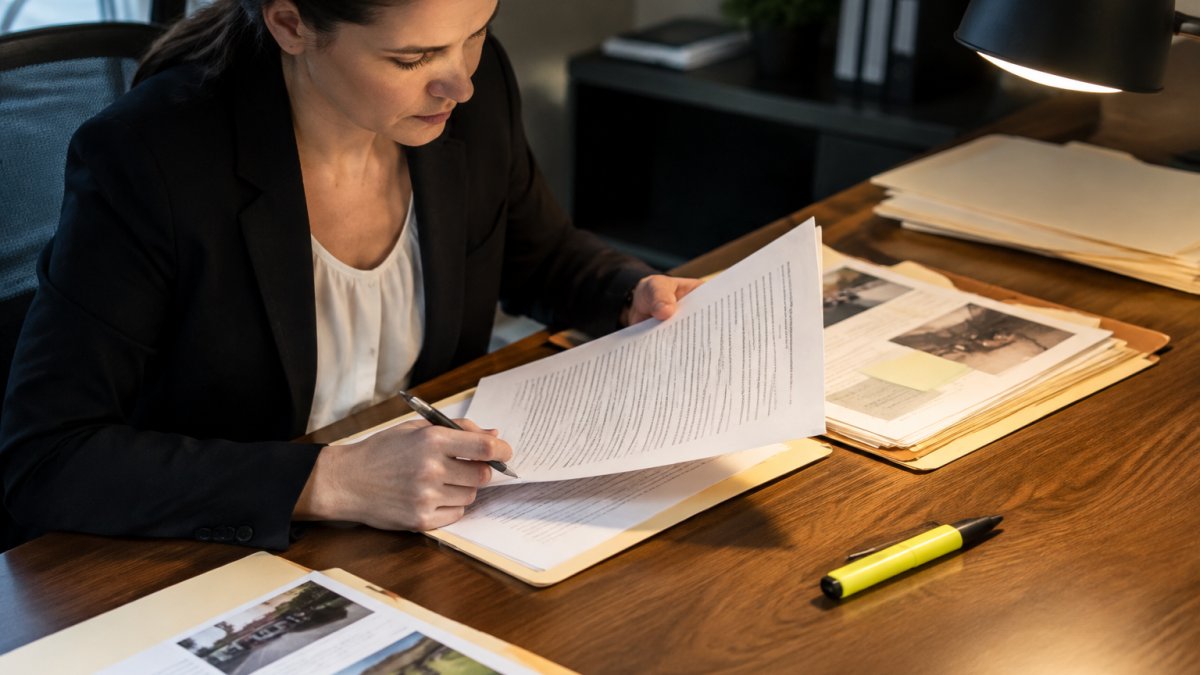
Step 1: Confirm the statement's identity and authorship
Before reading a single claim, establish who wrote the statement and whether the document is complete.
- The witness's full legal name, role, and relationship to the case appear in the header
- The statement is signed and dated by the witness, not only by counsel or an investigator
- The case reference, court, and matter number match the file
Watch out: a statement signed only by the attorney who prepared it, with no witness signature, is a draft, not a witness statement, treating it as evidence invites a challenge to authenticity.
Step 2: Trace every factual claim to a contemporaneous record
A factual claim is verifiable only if it points to something created at or near the time of the event. For each numbered paragraph, ask three questions:
- What is the source? A named record, a log file, a photograph with a capture time, a receipt, a dispatch record, a contemporaneous note, not "my recollection" or "the file."
- When was the source created? A record made weeks after the event carries less weight than one made the same day, and the statement should say which it is.
- Can a third party find the same source? If the record is not identified by name, date, and location, the claim cannot be independently checked.
A common pattern is a statement citing "the emails" or "the records" without identifying which ones. That is a gesture, not a citation. Replace it with a specific identifier, sender, recipient, date, subject line, and exhibit number.
Step 3: Separate observation from inference
The most frequent defect in forensic statements is a conclusion dressed as an observation. Test each sentence: could a camera have recorded this, or did someone have to interpret it?
- Observation: "The log shows 14 login attempts from one IP address between 2:04 a.m. and 2:41 a.m."
- Inference: "The account was compromised by someone with knowledge of the credential structure."
The first can be checked against the log. The second requires a method, stated assumptions, and a labeled opinion section. Every inference should be flagged and tied to its supporting reasoning.
Step 4: Test the scientific and methodological basis
If the statement relies on any analysis, a timeline reconstruction, a hash comparison, a financial calculation, a tool output, verify the method, not just the result.
- The method is named and is one generally accepted in the relevant field
- The tool and version used are identified, where a tool was used
- Calculations can be reproduced from the figures shown
Under Federal Rule of Evidence 702, an opinion must rest on sufficient facts, a reliable method, and proper application of that method.
Step 5: Check internal consistency and cross-document consistency
Read the statement against itself and against the rest of the file.
- Dates, times, and time zones are consistent throughout
- Names, titles, and identifiers are spelled and formatted the same way in every document
- The sequence of events in the statement matches the sequence in the underlying records
Discrepancies are not automatically fatal, but an unexplained one is. If the witness's earlier account differs, the statement should acknowledge and explain the difference.
Step 6: Confirm the witness reviewed and adopted the final version
A statement is the witness's document, not the preparer's. Confirm the witness read the final version, that any changes were shown to them, and that the signature reflects the version in the file.
For the underlying admissibility framework, our guide on ensuring evidence is admissible in court covers authentication and preservation.
Verification runs as a fixed sequence, and each step depends on the one before it.
| Step | What to do | Key check |
|---|---|---|
| Step 1 | Confirm identity and authorship | Signed and dated by the witness, not only counsel |
| Step 2 | Trace every factual claim | Named source record created near the event |
| Step 3 | Separate observation from inference | Could a camera have recorded this? |
| Step 4 | Test scientific and methodological basis | Method named, tool and version identified |
| Step 5 | Check internal and cross-document consistency | Dates, times, names, and figures match |
| Step 6 | Confirm witness reviewed and adopted final version | Signed version matches the file |
Verifying Digital Documents and Tracing Every Source Record
Digital evidence adds a layer most statements ignore. Metadata can be altered, timestamps manipulated, and a screenshot proves almost nothing on its own. Verification here means answering two questions: is this file what it claims to be, and can every claim be traced to a native source?
Establish document integrity before you read the content
Integrity checks confirm a file has not changed since collection. The standard mechanism is a cryptographic hash, a fixed-length value computed from the file's contents (hash function - Glossary).
- A hash value (SHA-256 is the common choice) was computed at collection and recorded in the chain-of-custody log
- The hash was recomputed before analysis and matches the collection value
- The hash is recorded again at production, so the receiving party can confirm the same file
Watch out: a hash recorded only after the file was opened, copied, or converted proves integrity from that point forward, not from collection, the chain-of-custody log must show the hash was taken at seizure or export.
Inspect metadata, but do not trust it alone
File metadata, creation and modification dates, author fields, software identifiers, and GPS data, is useful corroboration and weak proof. Metadata is easy to edit and easy to strip during export.
- Compare metadata timestamps against independent records: server logs, email headers, system event logs, or the recipient's copy of the same file.
- Treat a metadata timestamp that conflicts with the surrounding record as a question to resolve, not a conclusion to draw.
- Note when metadata is absent, because export and messaging platforms routinely strip it.
A file whose metadata says it was created on a date the sender was out of the office is not necessarily altered, but the statement should address the discrepancy rather than ignore it.
Trace to the native source, not the screenshot
Every digital claim in the statement should trace back to a native export: the original email with full headers, the server log in its native format, the database extract with its query, the device image rather than a screen capture.
- Identify the native source for each digital claim, the system of record, not a derivative.
- Document the collection method, who exported it, with what tool, on what date, and under what authority.
- Preserve the export in native format alongside any readable rendering, because conversion can lose fields.
- Link the exhibit to the claim, the statement paragraph should cite the exhibit number and the specific field or entry relied on.
A screenshot with no native source behind it is a picture of a claim, not evidence of one. If the native source is unavailable, the statement should say so and explain why.
Maintain a defensible chain of custody for digital files
Chain of custody for digital evidence is a log, not a memory. At minimum it should record:
- Each transfer of the file, with date, time, and the identity of the person receiving it
- Each access event, including who opened the file and why
- The storage location at each stage and whether it was encrypted
Gaps in the log are the first thing opposing counsel will probe, and an unexplained gap is harder to defend than a documented one.
Verify electronic signatures and version history
Where a statement or exhibit is signed electronically, confirm the signature is tied to the signer and that the signed version is the version in the file.
- Check that the electronic signature record identifies the signer, the date and time, and the document version signed.
- Compare the signed version against any later version; if the document changed after signing, the signature does not cover the change.
- Preserve prior drafts and version history, because they show what changed and when, and a concealed edit is far more damaging than a disclosed one.
When the stakes justify live testimony on digital evidence, our article on whether expert testimony for digital evidence is worth the cost walks through the trade-offs.
Red Flags, Corrections, and How to Handle a Disputed Statement
Watch out: the most common red flag is a statement that reads too cleanly, with conclusions presented as if they were observations.
When a statement is disputed, do not patch it quietly.
In family court matters, where statements face aggressive challenge, our guide on expert testimony in family court explains how preparation differs.
A statement that cannot be verified is not evidence; it is a risk.
Frequently Asked Questions
What is a forensic witness statement?
A forensic witness statement is a signed written account of what an investigator or expert personally observed, did, and concluded during a forensic examination, set out in chronological order with the source records behind each claim. It is not a summary of the case and not a legal argument. Its purpose is to preserve observations in a form that can be tested later in court, which is why every fact in it should trace back to a document, a photograph, or a recorded interview.
How is a fact witness different from an expert witness?
A fact witness testifies only about what they saw, heard, or did, and cannot offer opinions beyond everyday inference. An expert witness may give opinion evidence because they bring special knowledge, skill, experience, training, or education that the court lacks. In practice, one investigator can serve in both roles, but the statement should make clear which paragraphs are factual testimony and which are opinion, so opposing counsel cannot blur the line during cross-examination.
What makes a witness statement admissible in court?
Admissibility turns on relevance, reliability, and the rules of evidence that apply in the forum. For expert opinion, Federal Rule of Evidence 702 requires that the testimony rest on sufficient facts, use reliable methodology, and follow from the analysis. Under the Daubert standard, the judge acts as gatekeeper and may weigh whether the method has been tested, peer reviewed, or generally accepted. Statements that mix hearsay into factual claims, or skip the basis for an opinion, invite a challenge before the substance is ever heard.
How can a witness statement be challenged or discredited?
The usual attacks are procedural and methodological. Opposing counsel will look for gaps in the chain of custody, undocumented assumptions, inconsistent dates, opinions stated without a basis, and any hint of bias toward the party paying the bill. A statement that lists its source records, explains its analysis, and reads impartially survives far better than one that argues the case. Corrections should be documented, not erased, because a clean revision history is itself evidence of careful work.
How do you verify a forensic expert's qualifications and findings?
Start with the credentials: licensing, certifications, years of practice, and whether the person has actually testified and been accepted as an expert before. Then check the work. Confirm that every finding in the statement points to a named source record, that the methodology is described well enough for another examiner to repeat it, and that the conclusions stay within what the data supports. Ask for the underlying files, not just the report, and compare the statement's timeline against the original documents.
What should a witness statement template include?
A workable template covers the witness's identity and role, a statement of truth, the scope of the assignment, the records reviewed, a chronological account of findings, the methodology used, the basis for any opinion, and a signature with date. Add a section listing assumptions and any limits on the examination. Keep numbered paragraphs so counsel can cite them precisely, and leave a clear place to log corrections so the document stays traceable from first draft to signed version.